


What is “the West”? And how do we relate to it? Over the coming weeks, I will be pre-publishing excerpts from my book Wir und der Westen (und die Welt), ahead of the full English edition’s release under the title We and the West (and the World) later this year. The full list of excerpts is at the end of this post.
How did it come about that people in large parts of the world now use – or are at least able to decipher – the Roman alphabet? Around the year 1000 AD, there was no sign yet of this future. At that time, the alphabet’s use was confined to certain European scriptoria, monasteries, and secular official matters. Its use was very likely geographically limited to Western and Central Europe, particularly those parts of the former Western Roman Empire that had been Christianized in the meantime. This included the territories of the Holy Roman Empire, the British Isles, the areas of modern-day France, Italy, Spain, and Portugal, as well as, first to a limited extent, Scandinavia and Eastern Europe.
Alongside official administrative documents, it was particularly the Roman Catholic Church that played a central role in the alphabet’s dissemination. Its use in education, learning, and science was cemented in Latin schools and, from the 11th and 12th centuries onward, in the emerging universities.
Illustration: Political entities around 1000 AD in Europe and the wider region
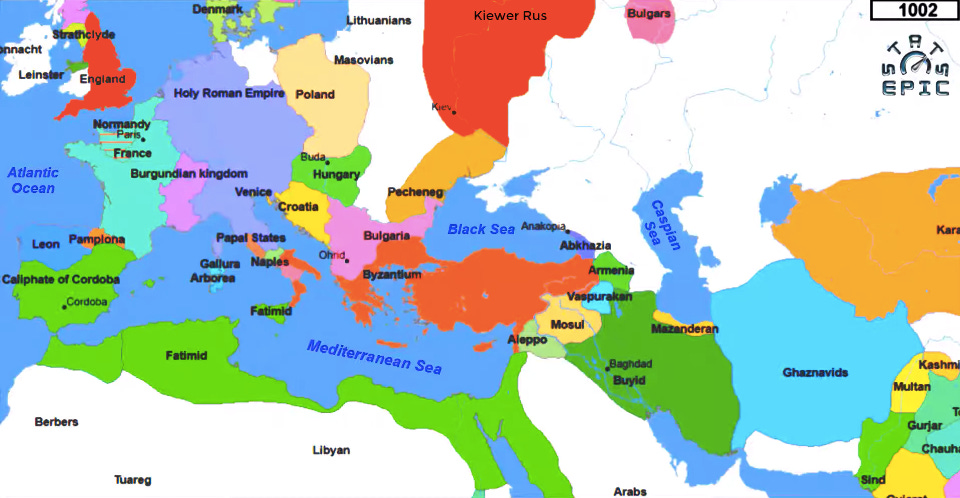
Source: Screenshot from Youtube (/watch?v=kwWxp4y
AmIo&ab_channel=EPICSTATS)
Insight into this facet of the Western world of that time can also be gained in what is now Switzerland, best of all perhaps at the Abbey of St. Gall and its Stiftsbibliothek (Abbey Library), whose origins date back to that very period and can convey certain impressions of it.
For the West to become a global civilizational reference, many more steps were required though. One of these was to direct the aforementioned imperial-missionary component outward. Within the papal-imperial dual structure of the Church on one side and empires and kingdoms on the other, circumstances would soon arise to pursue this aspect of its own character.
Illustration: Abbey Library of St. Gall (Stiftsbibliothek St. Gallen)
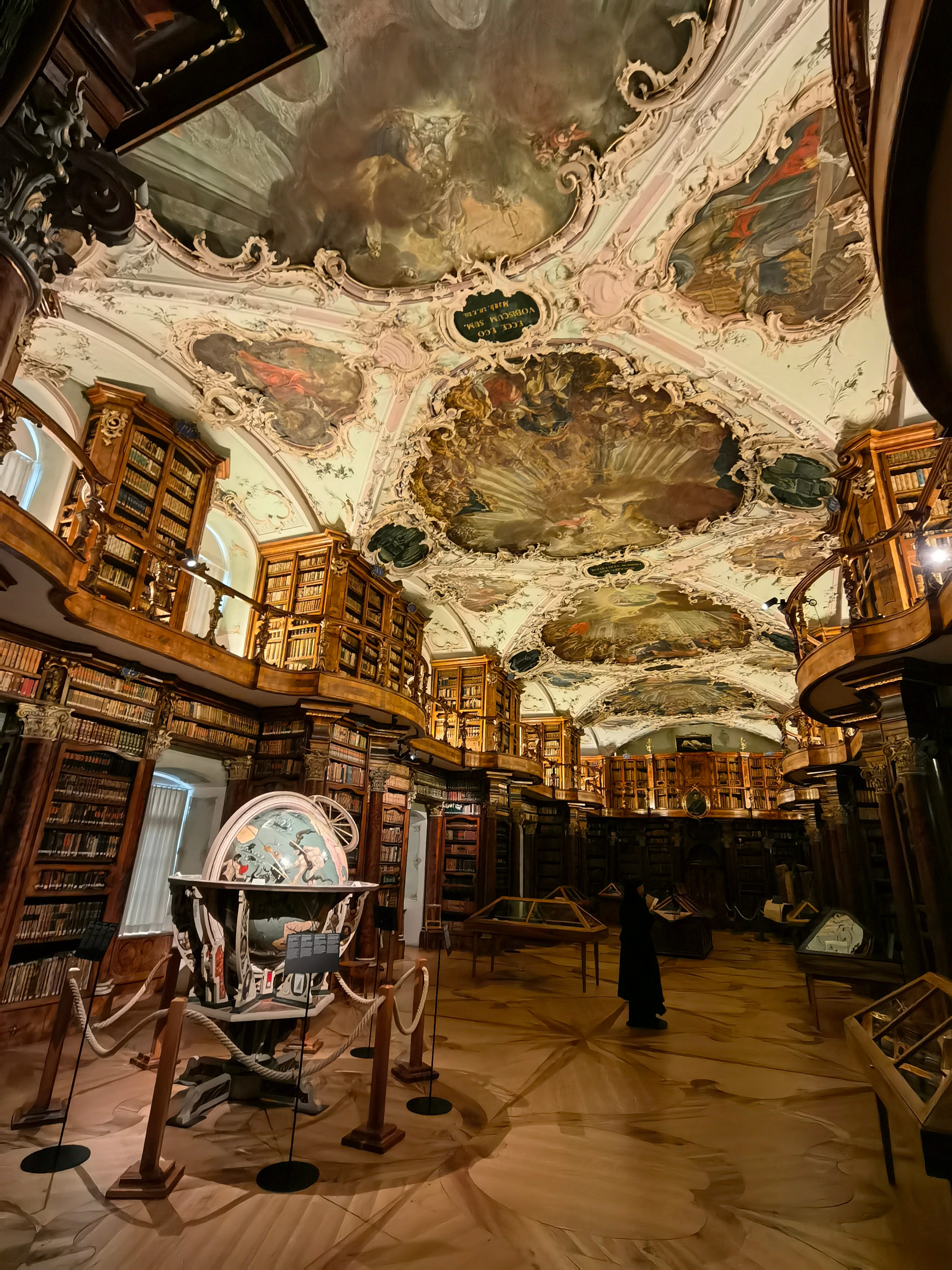
Source: Author’s photograph
But let us first turn to Switzerland, whose origins reach back into the early second millennium and serve well to illustrate that era. Indeed, Switzerland emerged right in the midst of what had, by then, matured into a civilizational entity we can properly refer to as “the West”.
The Alpine valleys and the Mittelland (”the middle lands”, as it is called, i.e. the less mountainous part, where the majority of the Swiss reside today) between the Alps and the Jura mountain chains were geographically situated at the very political and cultural center of the West, checking all the boxes. It was land previously settled by Celts, which was then Romanized and later Germanized, as well as Christianized, and under the influence of an imperial polity claiming continuity with ancient Rome. Although – or perhaps because – it was situated at the geographical heart of this order, the community of the central Swiss cantons forged itself in conflict with the established political order of the Western empire of the time.
From the Frankish Empire of Charlemagne, fractured by succession disputes, emerged the kingdoms of West, Middle, and East Francia, themselves the precursors to France and the Holy Roman Empire. This was the age of feudalism, a hierarchical sociopolitical system with at its heart the fief: a political authority – the king at the top, followed by noble families and monasteries – granted land to a subordinate. In return, the subordinate “vassal” – typically a knight – pledged military service and loyalty. At the base of this pyramid, serfs and bonded peasants worked the land, owing their manorial lord specific dues like a tithe (a tenth of their harvest) and corvée labor.
Within this feudal framework, the Staufers – a German noble family who also held the title of Holy Roman Emperor – exercised paramount authority over much of the territory of modern-day Switzerland during the 12th and 13th centuries, acting as the highest secular power in a complex patchwork of ecclesiastical lands and local nobles. However, the death of Emperor Frederick II in 1250 and the subsequent collapse of the Staufer dynasty created a power vacuum that various noble families attempted to fill.
Illustration: Europe around 1250
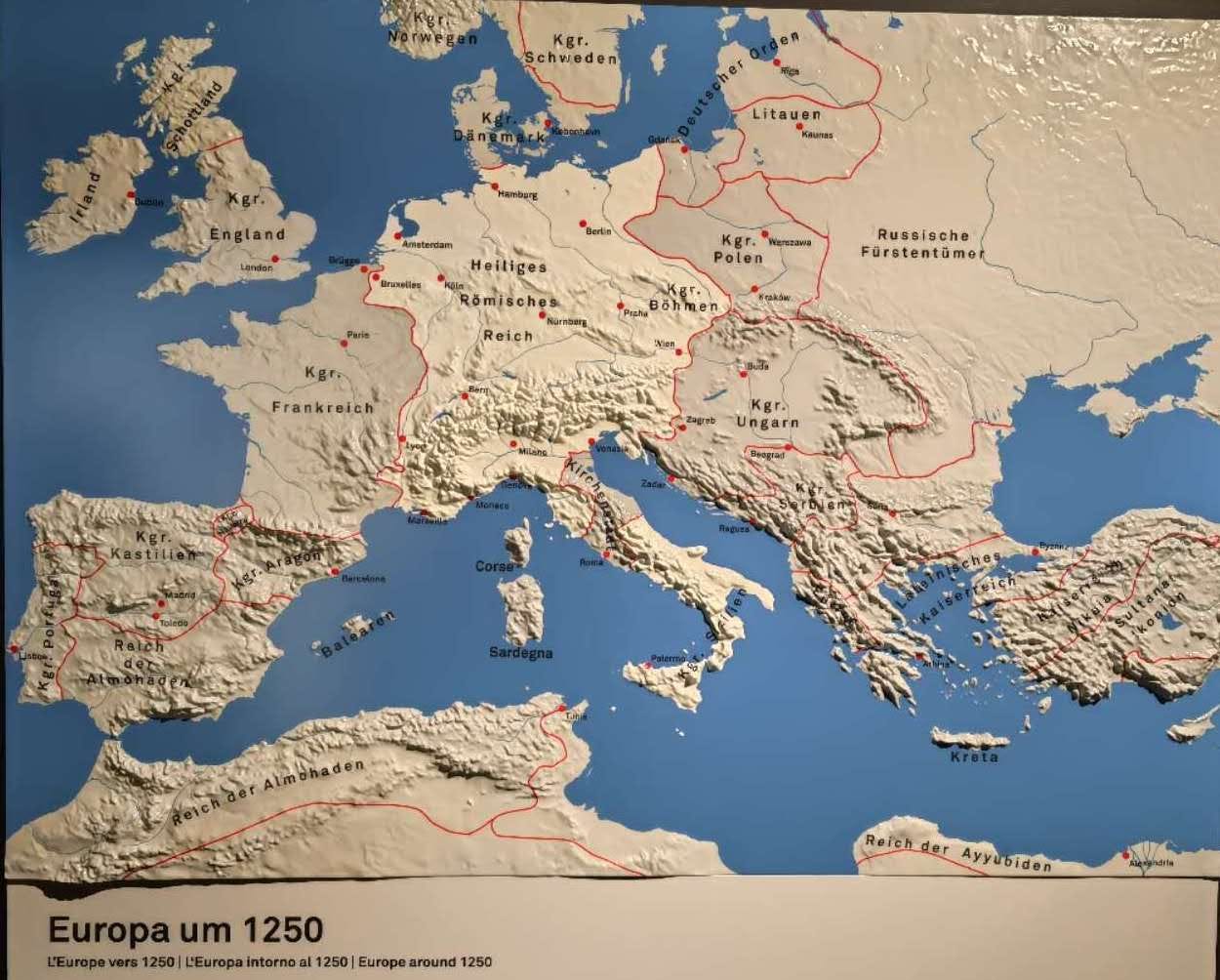
Source: Author’s photograph, Swiss National Museum, Schwyz, Switzerland
After the end of Staufer rule, the Habsburgs – another powerful noble dynasty, whose original ancestral seat was the Castle of Habsburg, built around 1020 in what is now the canton of Aargau above the Aare River – managed to take control over large parts of present-day Switzerland. From the 13th century onwards, however, the Habsburg family’s focus shifted to Austria, from where they went on to shape Europe’s imperial component as Emperors and Kings until the early 20th century.
The 12th and 13th centuries were a time of profound change in Central Europe, characterized by a commercial upswing, the rise of cities, and the spread of literacy. Crucially, a new north-south axis of trade emerged. While major routes had previously run through Savoy (today’s France) and Tyrol (today’s Austria), the 13th century saw the rise of the Gotthard Pass. Its ascent was made possible by the construction of the Teufelsbrücke (Devil’s Bridge) around 1230, which finally tamed the impassable Schöllenen Gorge up the Reuss river in the Alps. The Gotthard was now not only a vital trade artery but also a strategic prize.
Before that time, what is present-day central Switzerland had been of little attraction to foreign rulers. With the king being far away, and local Kyburg and Zähringer noble families having died out early, there was a low “nobility density” in the area. Though the Habsburgs kept an eye on the region and tried to expand their influence, disputes were increasingly settled through so-called feuds, a form of self-help justice. This chronic instability made transport routes unsafe and disrupted agriculture. In response, the communities of Uri, Schwyz, and Unterwalden, building on traditional agricultural cooperatives, began to take governance into their own hands. They established their own courts and local structures of order, bypassing the absent imperial or intermediate authority.
Illustration: Swiss Confederate and Habsburg Territories in the Year 1385
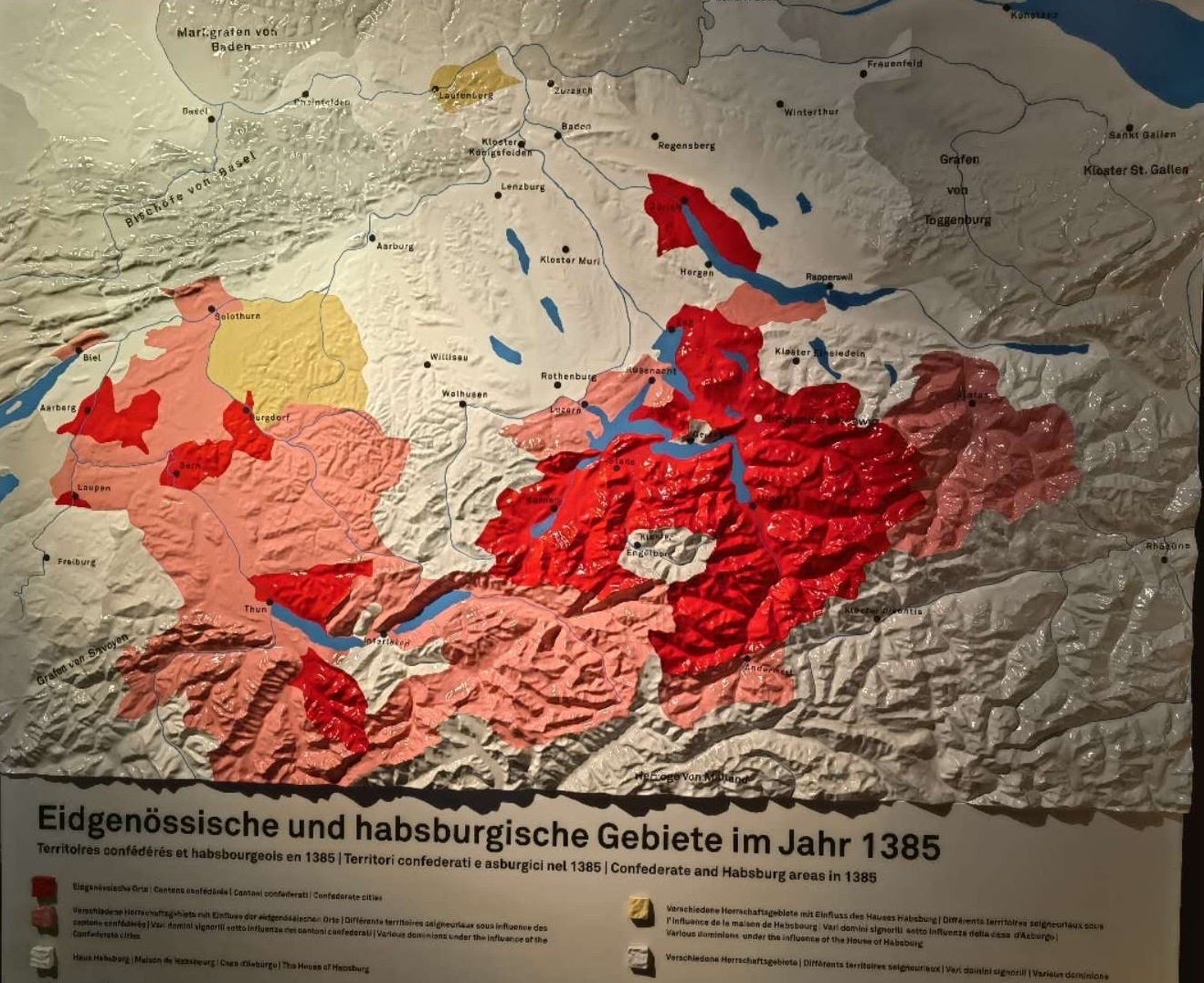
Source: Author’s photograph, Swiss National Museum, Schwyz, Switzerland
This was the decisive context for the birth of the Swiss Confederacy. To defend their autonomy and secure control over the critical Gotthard Pass, the three founding cantons of Uri, Schwyz, and Unterwalden united. During the 14th century, they successfully fought for and attained Reichsfreiheit, or imperial immediacy – a legal status that placed them directly under the Emperor, thus bypassing their immediate overlords, the Habsburgs, who were not yet emperors themselves, and granting the cantons de facto self-rule.
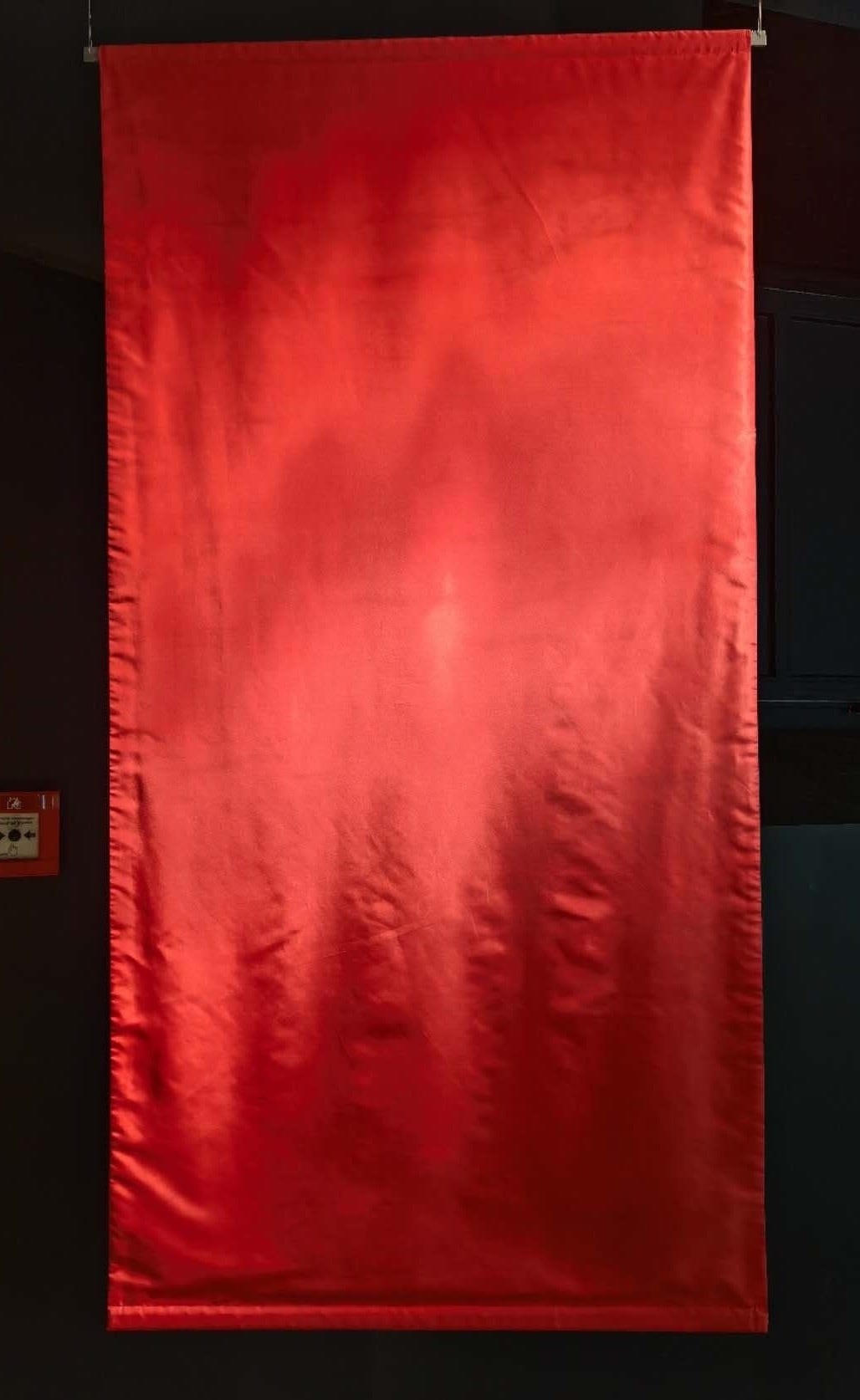
Illustration: Banner of Schwyz (in red, not yet bearing a cross)
Source: Author’s photograph, Swiss National Museum, Schwyz, Switzerland
Throughout its history, Switzerland has been part of a West characterized by imperial power structures. From its very inception, it has been paramount for Switzerland to engage in a constant and clever dealing with these structures. As we will see, this remains the core challenge for the Swiss today. What is changing, however, is the West’s centrality in the world.
PRE-PUBLISHING HERE OVER THE COMING WEEKS
Excerpts from We and the West (and the World):
I. The West’s Emergence as a Historical Civilization
→ 1/11 The “West” Merely Relative? – Geographically Western Eurasia
→ 2/11 First Traces of the West 2500 Years Ago?
→ 3/11 Ancient Greece as a Key Reference – Not Only for the West
II. The West’s Trajectory toward Modernity
→ 4/11 Switzerland’s Emergence at the Heart of the West
→ 5/11 Western Expansion and Imperial Continuity
→ 6/11 The West in Modernity – The Measure of Almost All Things
III. The West as a Contemporary Entity
→ 7/11 The West in the Global Order
→ 8/11 Unipolar, Hegemonic, Transatlantic Biases
→ 9/11 Various Moral Souls in the West’s Breast
→ 10/11 Western Modes of Functioning – “Liberal” and “Democratic”?
→ 11/11 Barely Veiled Oligarchies? Truly Legitimate Social Order?
→ Bonus: Whither, Post-Unipolar West?